Regulate This
The Trump Card: What the xAI National-Security Filing Is Really About

⚡ THE BIG STORY
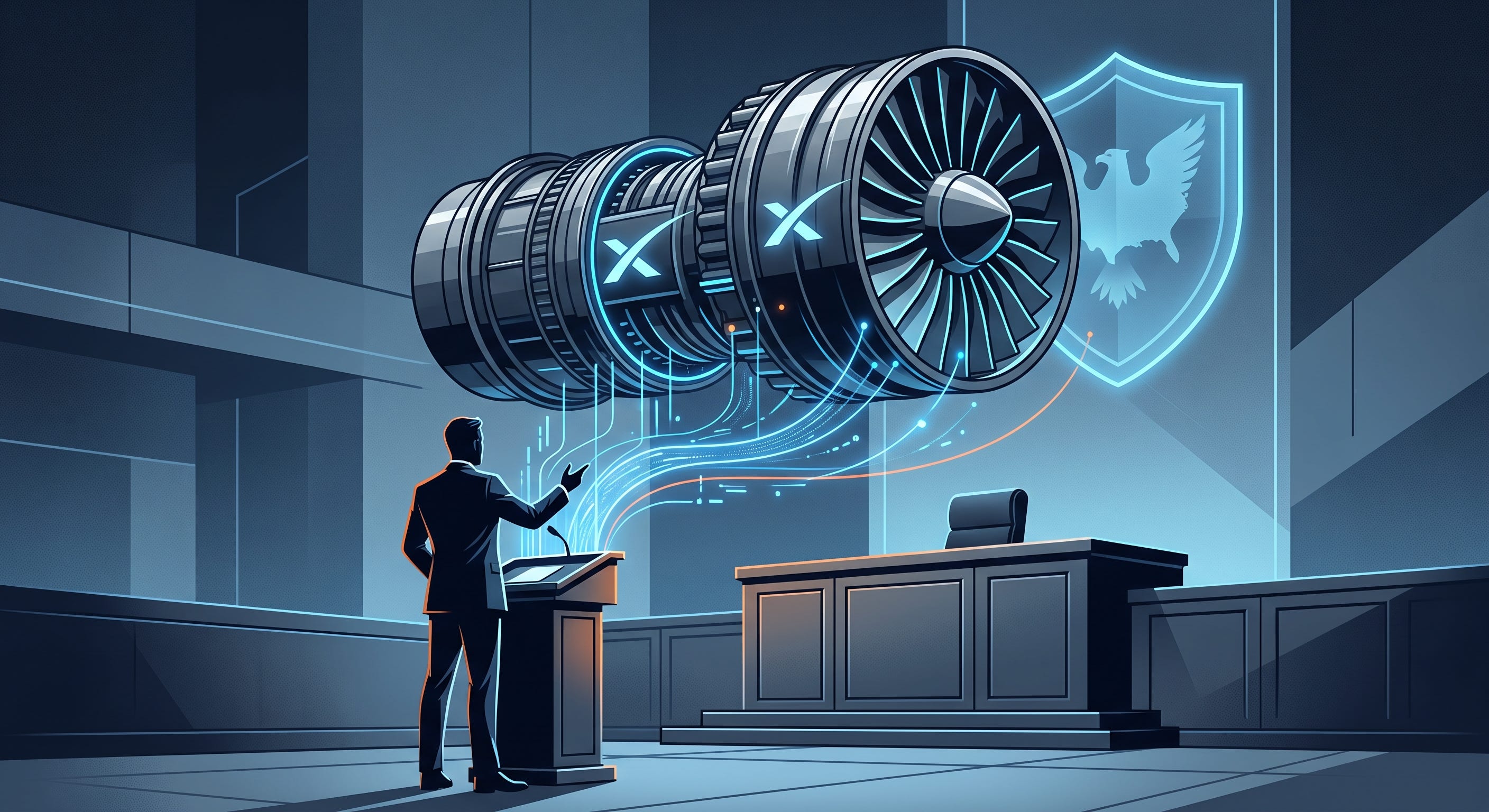
This past week, the Department of Justice walked into a federal court and argued that Elon Musk’s gas turbines are a matter of national security. The mainstream story writes itself: the NAACP sues, the administration pulls rank for its biggest donor, a Clean Air Act case turns into a culture-war flashpoint. All true. All beside the point. The question worth asking is the one nobody is asking: why did it come to this at all?
On June 16, DOJ moved to intervene in the NAACP’s suit against xAI and asked the court to throw it out — not because xAI complied (it concedes the turbines powering its Colossus supercomputer near Memphis lack a Clean Air Act permit), but because Grok is one of only four frontier AI models cleared for classified military work, and the Pentagon says cutting its power is a national-security risk. Strip away the politics and something genuinely new is sitting there: the federal government has declared that the electricity feeding AI compute is part of the national defense base. For anyone building dispatchable power, that precedent is enormous. But it’s also a tell.
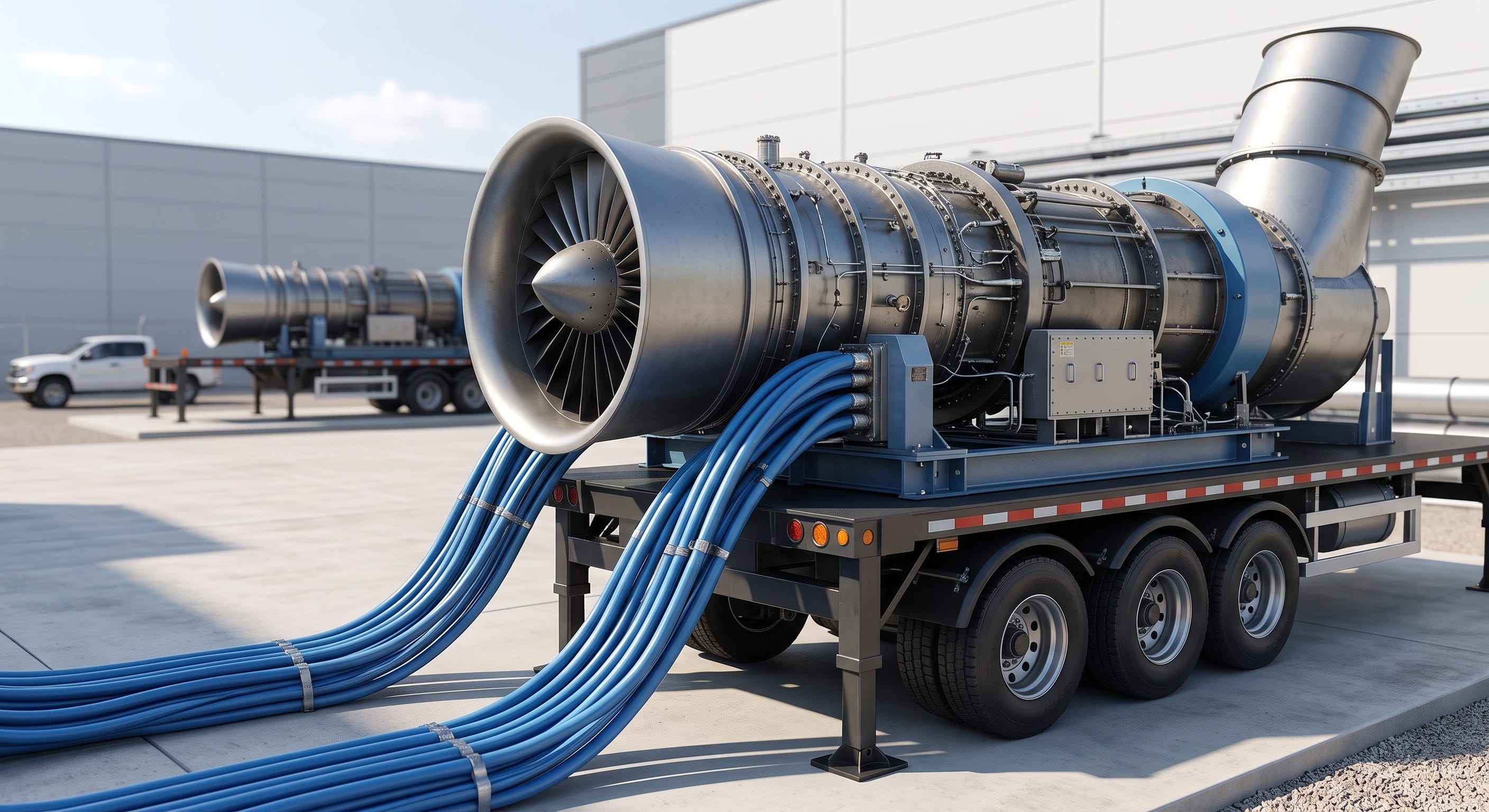
Because two extraordinary things had to happen to get here, and both point at the same culprit. First, the most resourced builder on the planet had to jury-rig a power plant out of a “temporary turbine” loophole — running trailer-mounted units under a nonroad-engine exemption — just to energize 100,000 GPUs in 19 days, a feat Nvidia’s Jensen Huang says normally takes four years. Then, when the EPA closed that loophole in January, Washington had to reach for the single most powerful card in the deck to keep the lights on. Ask why a private company had to find a backdoor, and why the government then had to play a trump card to defend it. Same answer to both: a permitting bureaucracy so slow that the legal front door is functionally shut.
How slow? In the early 2000s — the last great American gas build — you could order a turbine and run a plant in about two years. Order one today and the major OEMs are booked into 2029; a greenfield plant ordered now realistically comes online around 2032. Stack a four-to-five-year interconnection queue on top, and the math is impossible for data centers that need power in 2026. In a market moving this fast, delay is denial. A three-year permit review for a project that needs power in eighteen months isn’t process — it’s a pocket veto with no fingerprints. The loophole and the trump card are both just water finding its way around a dam.
And the lazy read — that this is a man indifferent to emissions — collapses on contact. He built Tesla and bankrolled SolarCity; few people alive have done more to put electric cars and rooftop solar into American life. The permanent turbines going in at the site are permitted and controlled. This fight was never about whether the power can be clean. It was about who controls the clock.
Now watch the machine work on itself. The DOJ’s filing puts one arm of the federal government — Justice — arguing directly against another — the EPA, whose own ruling closed the loophole in the first place. A federal judge in Mississippi decides the injunction in late August. The state of Mississippi made its own permitting call; the state of Texas, meanwhile, just builds. Every branch and every level is pulling in a different direction at once. To the mainstream that looks like chaos and corruption. To anyone who’s read the Constitution, it looks like the design.
This is the part the doomscrollers miss, and it’s a big reason the US keeps out-building Europe in frontier tech. By one widely cited count, the United States produced forty notable AI models in 2024. Europe produced three. That is not a talent gap — Europe has world-class engineers — it is a structural one. Between 2019 and 2024 the EU issued more than 13,000 new regulations to America’s 5,500; Mario Draghi’s own competitiveness report calls it a “morass,” counting roughly 100 tech-focused laws and 270-plus digital regulators across the bloc, and warns of an existential decline without radical reform. A year later, barely a tenth of his recommendations had been adopted — because the structure resists undoing.
That is the whole difference. In America, a state can break from the pack — Texas can decide to be the fast jurisdiction and dare the rest to catch up or lose the capital. In Europe, Brussels writes one rule for twenty-seven nations, and member states can only pile friction on top, never undercut it. There is no Texas option, no release valve, no single jurisdiction free to prove the faster path works. Even the continent’s power grid is thousands of fragmented providers that can’t move electricity efficiently across borders. America’s redundancy — separation of powers at the top, fifty competing states beneath — is loud, litigious, and maddening. It is also the immune system. When the federal process seizes, a state routes around it. When an agency overreaches, a court or a rival agency checks it. The xAI fight isn’t the system breaking. It’s the system working exactly as intended.
So don’t wait on Washington to fix permitting. Build where the system says yes fastest, and let the slow jurisdictions watch the gigawatts — and the tax base — move south and west. The national-security card is a backstop, not a strategy. The strategy is to plant capital where the front door actually opens. And in this country, there is always a door that opens. Build clean, build controlled, and build now.
💰 DEAL SHEET
DOJ intervenes for xAI on national-security grounds (June 16). Justice asked a federal court to dismiss the NAACP’s Clean Air Act suit, citing Grok’s role in classified military operations. The filing doesn’t dispute that the turbines are unpermitted — it argues national security outweighs the violation. First time the federal government has framed AI compute’s power supply as defense infrastructure.
EPA closed the “temporary turbine” loophole (January 2026). Trailer-mounted turbines used for primary power can no longer be classified as “nonroad engines” — they need Clean Air Act permits. The bridge that let xAI energize in weeks now runs through federal permitting. DOJ is effectively arguing against its own EPA.
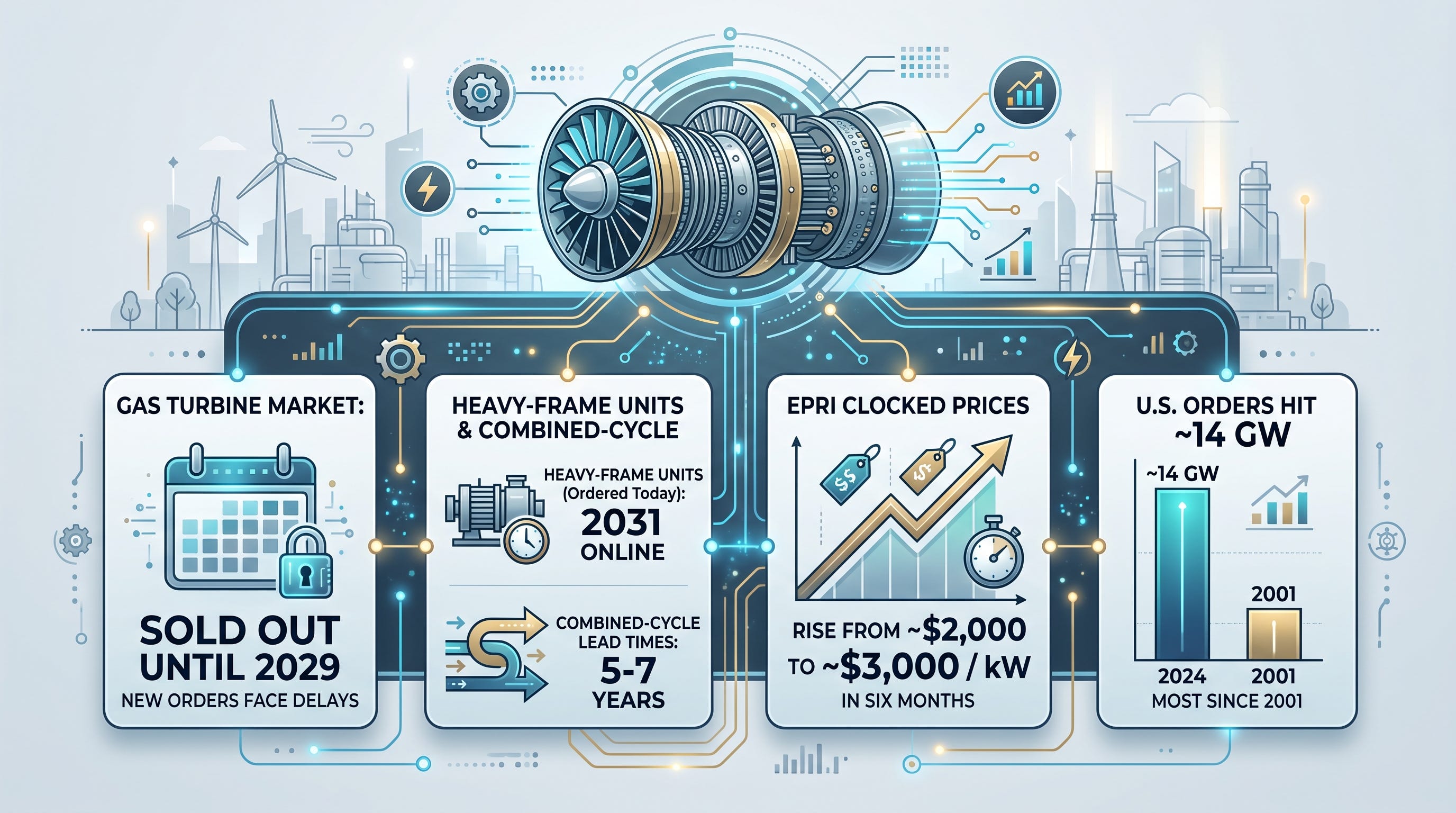
Gas turbine market — sold out into 2029. Heavy-frame units ordered today come online around 2031; combined-cycle lead times run five to seven years; EPRI clocked prices rising from ~$2,000 to ~$3,000 per kW in six months. U.S. orders hit ~14 GW in 2024, the most since 2001.
Texas SB6 and the queue. The first comprehensive large-load interconnection framework in the country, signed June 2025. ERCOT’s large-load queue went from ~63 GW in December 2024 to over 200 GW a year later — because developers believe they can reach yes.
ENGIE pulls two Texas peakers. Equipment-procurement delays pushed the schedule past the deadline to draw its Texas Energy Fund loan. A live example of the clock killing a project before it starts.
📊 DATA POINT OF THE WEEK
40 to 3. By one widely cited count, the United States produced 40 notable AI models in 2024. Europe produced three. Same caliber of engineers, same access to capital markets, wildly different output — and the variable that explains it isn’t talent, it’s the speed at which each system can say yes. The EU issued more than twice as many regulations as the US over the last five years and still can’t scale a frontier lab. The lesson for capital is blunt: it compounds where the front door opens fastest. Right now that’s here.
🔥 HOT TAKE
Everyone says developers are flocking to Texas for the taxes. Wrong. They’re flocking for the one thing Europe can’t offer: a release valve.
Texas gets written up as a tax story. The real magnet is regulatory posture. Texas produces more wind power than any state in the country, is adding solar and battery storage faster than anyone, and renewables now cover more than a third of its grid — so much for the fiction that fast permitting and clean power are opposites. But Texas moves. It built the nation’s first real on-ramp for hyperscale load while other markets were still forming study committees. It behaves like a partner, not an overlord — a process designed to say yes instead of a process designed to delay. That option simply doesn’t exist in a system where one capital writes the rules for everyone and nobody can opt for speed. It’s the American Way: ambition, speed, a bias toward building. Watch the rest of the South run the same play. Oklahoma, Louisiana, Mississippi, Alabama — open for business, and about to eat the lunch of every jurisdiction that treats a permit application like a hostage negotiation.
📡 ON MY RADAR
The xAI injunction hearing (late August). Whether a court lets a national-security argument override Clean Air Act permitting — with DOJ on one side and the EPA’s own ruling on the other — is precedent either way, and the template every hyperscaler’s lawyers will copy or avoid.
EPA’s next move on “mobile sources.” The January ruling may open a pathway to reclassify backup generators as mobile sources — fewer requirements, faster behind-the-meter power. If it lands, it resets the speed-to-power math nationwide.
The Southern queues. Oklahoma, Louisiana, Mississippi, Alabama. Cheap gas, available land, regulators who pick up the phone. Track the interconnection numbers — that’s where the next wave of dispatchable build is heading.
Does Europe actually deregulate? Draghi prescribed a “regulatory pause” and simplification. A year in, almost nothing moved. If the EU can’t undo its own rules even when its own central banker says it must, the structural gap with the US widens — and so does the case for building here.
If this is useful, forward it to a colleague trying to make sense of the AI power buildout. And if someone sent it to you, subscribe at powersignal.substack.com so you don’t miss next week’s issue.
https://www.utilitydive.com/news/doj-intervenes-xai-data-center-gas-turbine-lawsuit/823267/
The Deep State has become the Dead Hands dragging us to join them in the grave.