ERCOT’s Large-Load Rules Will Make or Break $50B in AI Infrastructure. Here’s What the Draft Actually Says.
The Texas PUC just proposed interconnection requirements that will reprice every data center project in the state — here's what the math actually means.

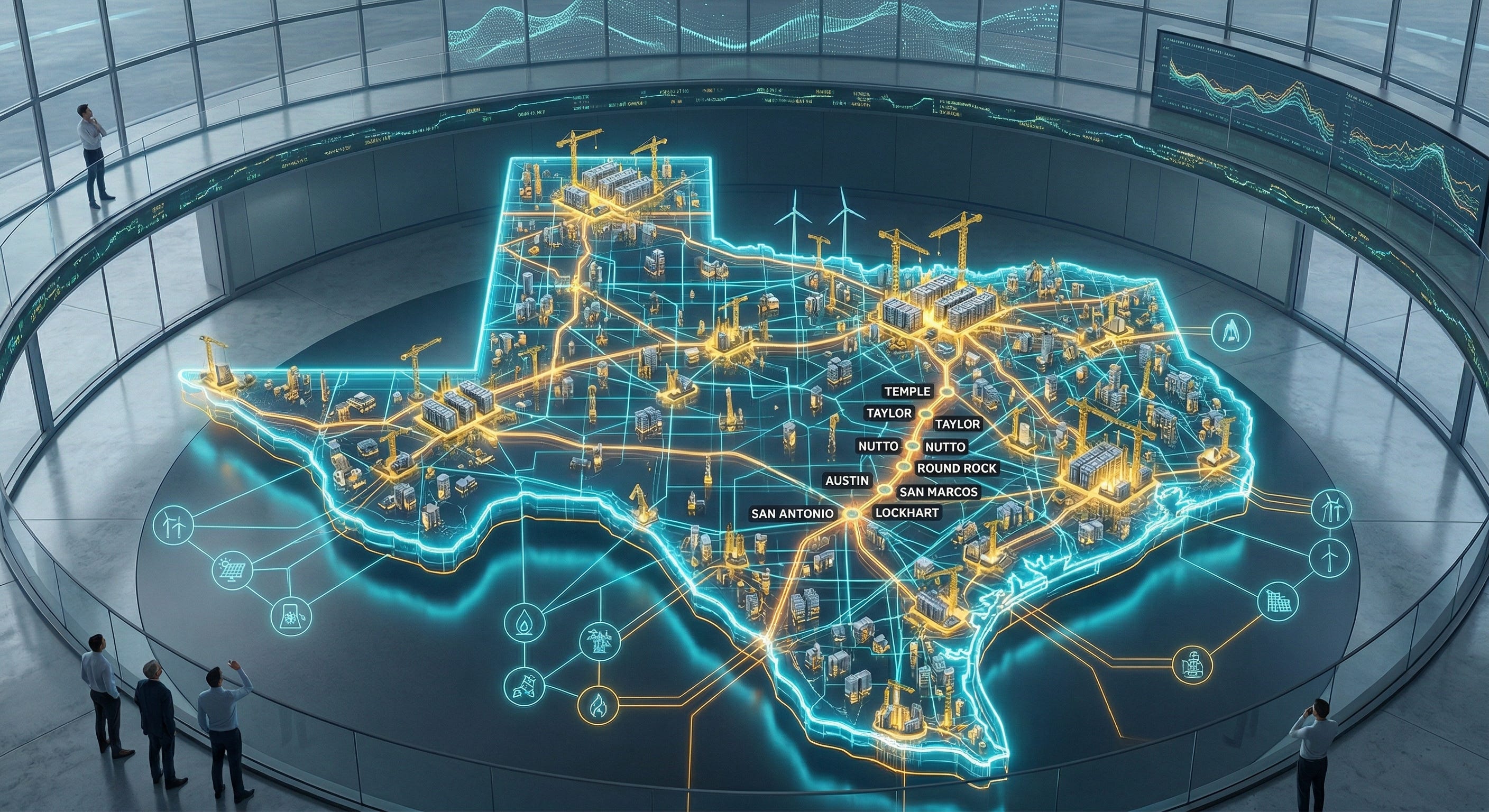
The Texas PUC just dropped a proposed rulemaking on large-load interconnection standards that, if adopted as written, will reprice every data center project in ERCOT. I’ve been through the filing. Some of what’s in there is reasonable. Some of it will kill deals that penciled six months ago. All of it matters — because whatever Texas adopts here doesn’t stay in Texas.
Let me start with why this rulemaking exists at all.
ERCOT is absorbing load growth at a pace the grid was never designed to handle. The queue today sits north of 300 GW of generation requests — a number that would have seemed fictional five years ago. On the demand side, large industrial and data center load requests have exploded: ERCOT staff flagged over 40 GW of large-load interconnection requests in recent queue cycles, with hyperscale and AI-adjacent facilities accounting for the majority of new volume. The grid operator is simultaneously trying to connect new generation, connect new load, and maintain reliability. That’s a genuinely hard problem. The PUC’s proposed standards are their attempt to solve it through process — by creating defined requirements, cost-allocation frameworks, and operational standards for large loads that want to interconnect at scale.
The question isn’t whether ERCOT needed rules. It’s whether these rules allocate costs fairly and preserve the project economics that brought $50B+ in announced AI infrastructure investment to Texas in the first place.
Here’s what matters for developers and investors.
The proposed framework introduces requirements for large loads above a certain MW threshold, the concept being that a data center or industrial facility seeking to interconnect at scale must demonstrate financial security, detailed planning and transparency. On the surface, this sounds like a reasonable reliability measure. In practice, it creates a new cost layer that didn’t exist in prior project underwriting. If you’re a data center developer who signed an LOI on a Texas site in Q3 2024 assuming a straightforward utility-scale interconnection, you are now potentially on the hook for costs and extended study timelines that you never modeled.
Let’s walk through the parts that will actually cost you money.
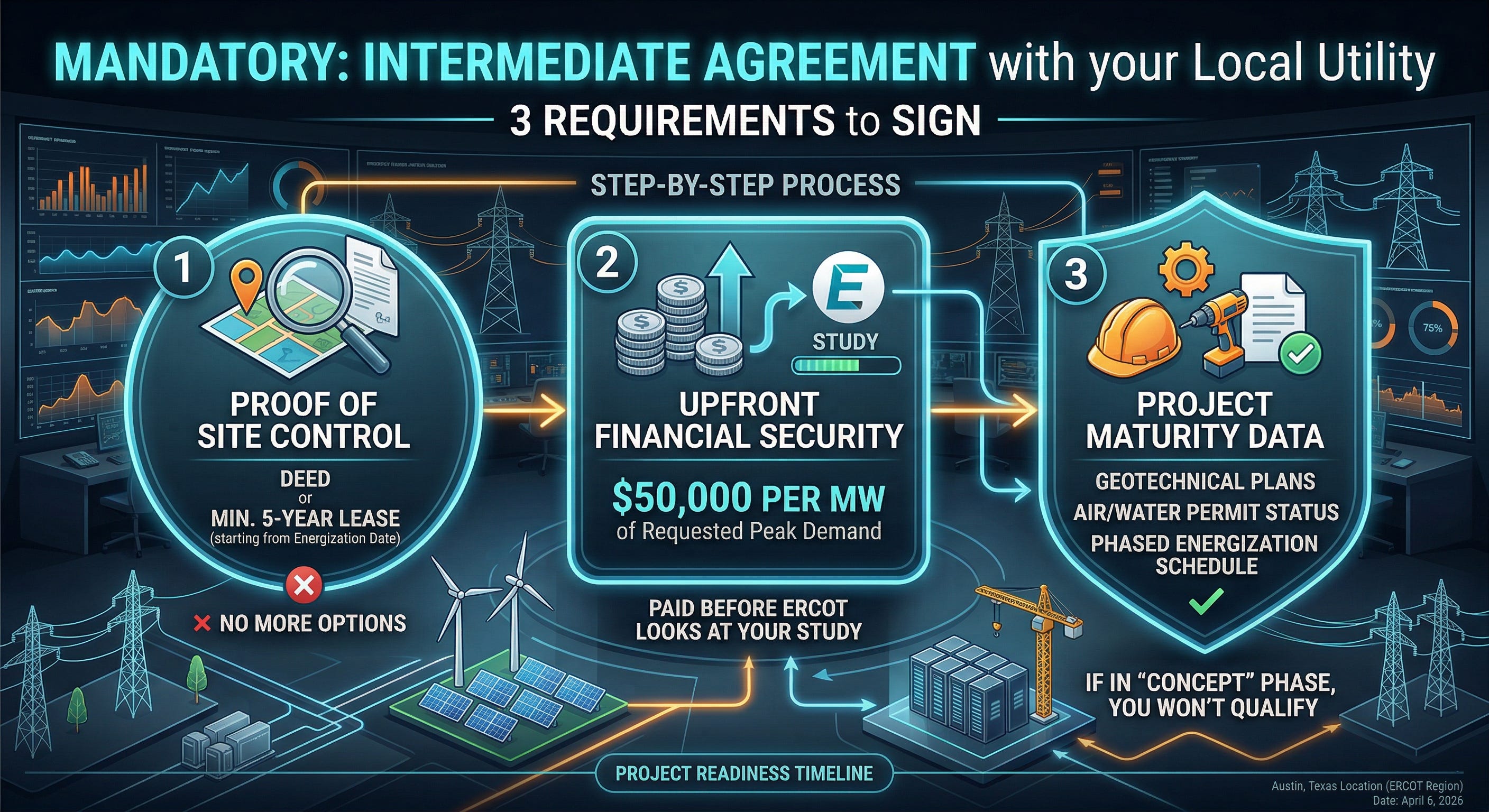
First, there is a mandatory “Intermediate Agreement.”
You can no longer just submit a study request to ERCOT. Under the proposed §37.0561, you must first sign an “Intermediate Agreement” with your local utility. To sign it, you need three things:
Proof of Site Control: A deed or a minimum 5-year lease starting from your energization date. No more options.
Upfront Financial Security: $50,000 per MW of your requested peak demand. For a 500 MW campus, that is $25 million in cash or a letter of credit from an A-/A3 rated bank. You pay this before ERCOT even looks at your study.
Project Maturity Data: You must provide geotechnical plans, air/water permit status, and a phased energization schedule. If you’re still in the “concept” phase, you won’t qualify.
Second, the cost of the interconnection itself just went up substantially.
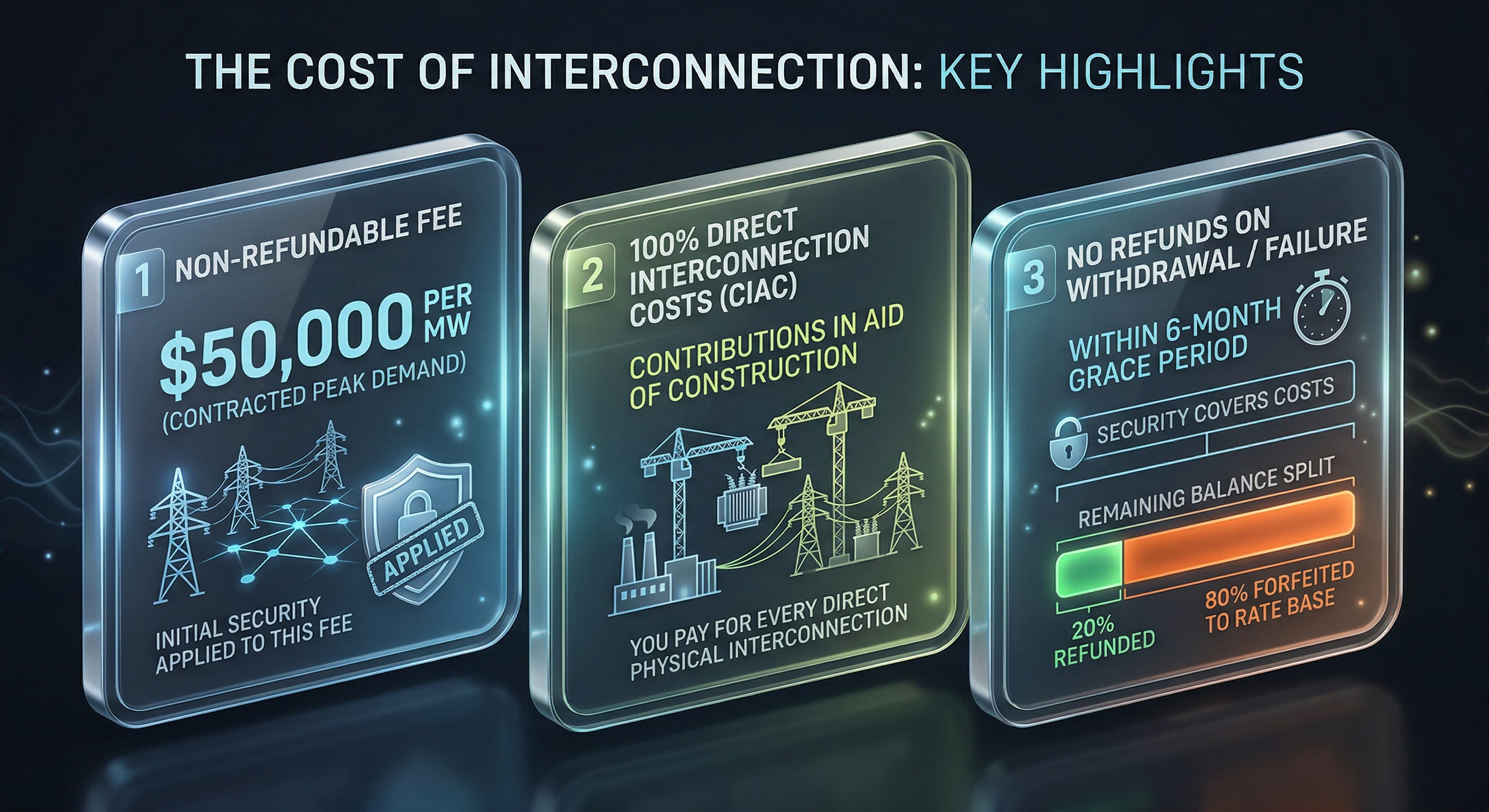
The old model allowed you to negotiate allowances. The new model prohibits them entirely. Here is the actual cash flow you will face within 30 days of completing your interconnection study:
Non-Refundable Interconnection Fee: $50,000 per MW of contracted peak demand. For that 500 MW campus, that’s another $25 million that you will never see again, even if you build the project. Your initial security gets applied to this, but the point stands: this is a sunk cost.
100% of Direct Interconnection Costs (CIAC): You will pay for every directly required pole, wire, and substation upgrade via a “Contribution in Aid of Construction” (CIAC). The utility gives you no allowance. Zero.
No Refunds: If you withdraw, fail a milestone, or miss your energization date (plus a 6-month grace period), the utility takes your security to cover their costs. After that, you only get 20% of the remaining balance back. The other 80% is forfeited to the utility’s rate base. That is an 80% penalty for failure.
These financial thresholds are higher than those imposed by any other major US grid operator, where study deposits and interconnection fees for load customers are typically measured in the tens of thousands of dollars, not millions.
Third, the “5-Year Rule” changes your return model entirely.
Even if you build the project and turn it on, you aren’t safe. The proposed rule states that a full refund of your remaining financial security is only available after you sustain operations at contracted peak demand for five years.
If you ramp up slowly? You don’t get your money back. If your AI workloads shift and you curtail? You don’t get your money back.
What about transparency and risk?
The PUCT is also trying to kill “line-jumping.” At the Intermediate Agreement stage, you must disclose if you are pursuing “substantially similar” interconnection requests elsewhere that could delay or withdraw the Texas request.
And in an energy emergency? You must disclose on-site backup generation capable of serving 50% of your demand. ERCOT can then direct you to either deploy that backup or curtail your load. You are now a grid resource, not just a customer.
This will affect the rest of the country.
ERCOT’s regulatory decisions carry disproportionate weight because Texas is the largest competitive power market in the country and the single largest destination for new AI infrastructure investment. When the Texas PUC establishes a cost-allocation framework for large-load interconnection, PJM’s stakeholder process takes notice. MISO’s planning staff takes notice. The FERC large-load task force — which has been circling this issue for two years — takes notice. Whatever gets codified in Austin over the next 90 days will be cited in regulatory proceedings in at least four other ISOs within 12 months. Developers operating in PJM’s Western Hub zone or MISO’s Zone 7 should be reading this Texas rulemaking as a leading indicator of where their own interconnection economics are heading.

So what does this mean, and what should you actually do?
If you’re a data center developer or hyperscaler with active site selection underway in ERCOT, you need to model two scenarios right now: one where the requirements are passed as proposed, and one where they get softened through the comment process. The delta between those scenarios on a 500 MW campus is likely $100M to $200M in total project cost. That range needs to be in your investment committee materials before you commit to site control.
If you’re an infrastructure investor evaluating ERCOT-based power assets, the rulemaking creates a clear valuation signal: existing interconnection agreements in constrained load pockets are scarce, and they’re getting scarcer. A gas peaker or combined-cycle asset with a clean queue position adjacent to a Tier 1 data center corridor — think the I-35 corridor between Austin and San Antonio, or the Permian Basin edge where hyperscale announcements have been clustering — is a strategic asset, not just a power plant. Price it accordingly.
If you’re a developer trying to originate new projects in ERCOT, the comment period on this rulemaking is not a formality. The provisions are still being shaped. Developer coalitions that show up with specific, quantified objections — not generic opposition, but actual project-level impact analysis — have historically moved Texas PUC staff on interconnection cost questions.
The April 17th deadline matters. Get your comments in.
The days of securing a cheap interconnection study and hoping for the best are over. The new rule is designed to separate serious capital from speculative optionality. If you are a hyperscaler with a real shovel-ready site, this is manageable. If you are a developer holding an LOI and hoping to flip it, this rule will burn your deposit.
I know which outcome I’m underwriting against. I’d rather be wrong and pleasantly surprised than right and undercapitalized.
What are you seeing on the ground in Texas? Specifically — are your data center counterparties adjusting their site selection criteria in response to this rulemaking, or are they still underwriting to pre-rulemaking assumptions? I want to know what the buy side is actually modeling.
— Peter
Subscribe to Power Signal — it’s the one thing you need to read every week at the intersection of AI, power generation, and finance.
https://www.dlapiper.com/en-us/insights/publications/2026/03/texas-proposes-new-interconnection-standards-for-large-electric-loads
The developers discover the Tragedy of the Commons isn’t their gain, that the clear impending wave of bankruptcies from the bubble won’t be covered by the Texas and ERCOT consumers and residents.
This proposal means that gains will not be subsidized and costs socialized. Pay up front, when the other party demands a surety that means they understand you.
I’m RW but this is all to the good. If people cannot tell the difference between voluntary and informed investors and venture capitalists vs local consumers and residents who should in no way have their costs increased for power, water , roads or anything else then those people can find another country never mind another state.
This reeks of the housing finance bubble and sub prime all over again, I suspect it’s the same people (it usually is by name) pulling an improved version of the same game.
Try Asia , if you can find a country in Asia that has its own energy. The Asians that exist seem to have a problem with energy. Just in time just too late.
If you can’t tell the difference between gambling and socialism then find another country, none comes to mind… Qatar perhaps?